

Drug Shortages Are Down. Here's Why That's Not the Win It Sounds Like.
By Mike Johnston, CPhT-Adv | NPTA
Published June 24, 2026
The newest national numbers on drug shortages just landed…and on the surface, they read like good news. The total dropped for the second year in a row. But the real story is underneath that headline — and it’s the part that matters most to the people doing the work.
For pharmacy technicians, shortages have never been an abstraction. They’re the prescriber call, the backorder note, the patient at the counter who can’t understand why a medication they’ve taken for years suddenly isn’t there. So when a national report says things are improving, it’s worth asking what “improving” actually means.
It means something more complicated than the headline.
The short version: U.S. drug shortages fell for the second year in a row in 2025 — down 23% to 75 active shortages. But the ones that remain now last more than five years on average, discontinuations hit their highest level since 2019, and for the first time the data exposes how dangerously concentrated the upstream supply chain really is. Fewer shortages…harder problems.
At a glance:
- Year-end shortages: down 23% (98 → 75) — a second straight annual decline
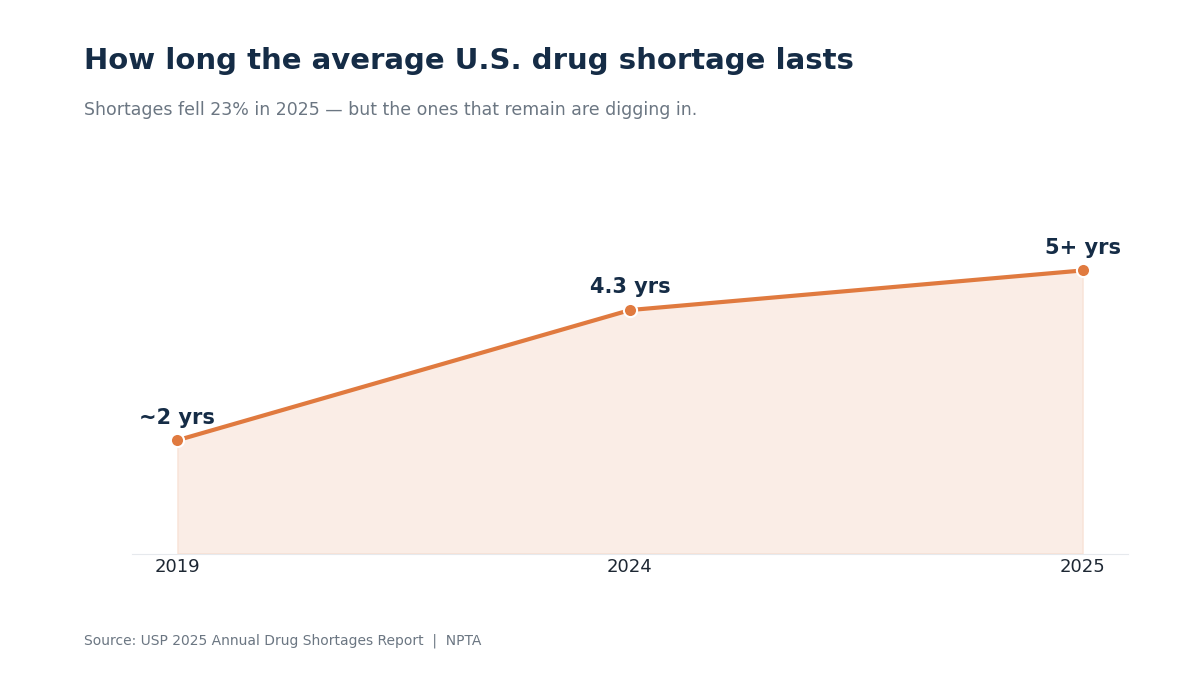
- Average shortage duration: now 5+ years (up from 4.3 years in 2024, ~2 years in 2019)
- Discontinuations: up 60% (106 → 170) — the most since 2019
- Upstream risk: 44% of shortage drugs rely on a single country for a key starting material
An insider's read
NPTA is a member organization of the United States Pharmacopeia (USP) — the same body that sets the quality standards behind the medications technicians handle every day. That seat matters here, because it means this isn’t a secondhand summary. What follows is a direct recap of USP’s 2025 Annual Drug Shortages Report, released in June 2026, and what it should mean to the people doing the work.
Are drug shortages actually getting better?
The top-line number is genuinely good. Year-end drug shortages fell 23%, from 98 in 2024 to 75 in 2025 — the second consecutive year of decline.
The trouble is what’s underneath that number. The shortages that remain aren’t easing; they’re hardening. Roughly 95% of the 75 active shortages carried over from the prior year. The average shortage now stretches beyond five years — up from 4.3 years in 2024 and about two years in 2019. And sterile injectables, the dosage form where a gap is most dangerous to patients, account for 71% of what’s left.
The picture, then, isn’t a problem being solved. It’s a smaller set of problems digging in for the long haul.
Why are drug discontinuations rising?
If shortages are the figure everyone tracks, discontinuations are the one that deserves more attention than it gets. In 2025 they reached their highest level since 2019 — a 60% jump, from 106 to 170.
The pattern beneath that rise is the real signal. Most discontinued products were priced well below the drugs in shortage; the median price of a discontinued oral solid fell 78% in a single year, from $1.80 to $0.40. Manufacturers aren’t abandoning the expensive drugs…they’re abandoning the cheap, essential ones…because the economics no longer work. That points to a structural weakness in the market, not a temporary manufacturing hiccup.
Where do drug shortages actually begin?
For the first time, USP traced the supply chain all the way upstream to the key starting materials that medications are built from — and the concentration risk runs deeper than the industry assumed.
Of the drugs in shortage, 44% depend on at least one starting material made in a single country. Six rely on a single country for all of their starting materials: four injectables sourced entirely from China, two oral solids entirely from India. The vulnerability doesn’t begin at the plant that presses the tablet. It begins far earlier, in places the data is only now bringing into view.
And the categories hit hardest aren’t fringe medications. Pediatric, gastroenterology, anesthesia, endocrinology, and oncology drugs were all among the most affected — the medicines that children, surgical patients, and cancer patients depend on.
What does this mean for pharmacy technicians?
No technician can repair a global supply chain. But the role is far from powerless. Technicians are often the first to detect a shortage forming…the ones who know the alternatives to surface for the pharmacist…and the steady presence for the patient who simply needs their medication. That work carries more weight when the supply chain is under strain, not less. Understanding why shortages happen is what makes a technician sharper in every one of those moments.
Knowing your worth includes knowing your field. This is your field.
Frequently asked questions
Are drug shortages getting better in 2025?
Yes and no. The total number of active U.S. drug shortages fell 23% — from 98 in 2024 to 75 in 2025 — the second straight year of decline. But the shortages that remain now last longer than ever, so the picture is improving in count while worsening in depth.
How long does the average drug shortage last now?
More than five years. The average duration of a year-end shortage exceeded five years in 2025, up from 4.3 years in 2024 and roughly two years in 2019.
Why are so many drugs being discontinued?
Discontinuations rose 60% in 2025 (from 106 to 170), the highest level since 2019, and most were low-priced drugs. When essential generics become unprofitable to manufacture, makers exit the market — a sign of structural weakness, not a temporary glitch.
Which medications are most affected by shortages?
Sterile injectables make up 71% of active shortages. Pediatric, gastroenterology, anesthesia, endocrinology, and oncology medications were among the hardest-hit therapeutic categories in 2025.
This is the recap. The full report is free, data-rich, and worth the time for anyone who wants to understand the forces shaping what is — and isn’t — on the shelf. Download USP’s 2025 Annual Drug Shortages Report here:
The shortage numbers are improving. The story beneath them is not…and the technicians who see that clearly are the ones the profession will lean on hardest.
About the Author

Mike Johnston is a nationally recognized pharmacy technician educator and advocate. As the founder of NPTA, he helps pharmacy professionals advance their careers through education, certification preparation, and continuing education programs.