

NPTA Topics Library · Billing & Insurance
How Prescription Insurance Really Works (Start to Finish)
Last updated August 12, 2026 · ~5 min read (free core) · Free essentials, members-only deep dive
Audience: Active, certified pharmacy technicians. You process claims all day — this page explains the system behind the screen: who’s involved, what happens when you transmit, and how the money actually moves. Free preview above the divider; members-only deep dive below. Troubleshooting rejects is its own topic — see “Insurance Rejections & How to Fix Them.”
Every prescription claim is a fast, invisible money transfer between a patient, a health plan, a middleman called a PBM, and your pharmacy — and once you see who’s who and how the dollars move, the whole system finally makes sense.
Why this matters to you
You run claims all shift, but the machinery behind them is a black box for most techs. Understanding it lets you answer the question you hear every day — “why does it cost this?” — and makes you the person who actually gets what’s happening, not just which buttons to press.
It isn’t only a retail skill, either. The same system drives hospital discharge and meds-to-beds, LTC cycle fills, and specialty/infusion billing.
The essentials
The players — who’s actually in a claim
A prescription claim involves more parties than most people realize:
- Member (patient) — Carries the coverage and pays a share of the cost.
- Plan sponsor — Who’s funding the benefit: an employer, a union, or the government (Medicare/Medicaid).
- Health plan / payer — The insurer administering coverage for the sponsor.
- PBM (Pharmacy Benefit Manager) — The middleman that actually runs the drug benefit: builds the formulary, sets the pharmacy network, processes claims, and decides what the pharmacy gets paid.
- Pharmacy — Dispenses the drug and gets reimbursed.
- Upstream — The manufacturer (makes the drug, pays rebates) and the wholesaler (supplies the pharmacy).
The PBM is the one most techs underestimate — it sits in the middle of nearly every dollar.
What happens the instant you hit “transmit”
Your claim doesn’t go to “the insurance.” It goes to the PBM’s rules engine, which in about a second:
Confirms the patient is eligible (covered, today).
Checks coverage — is this drug on the formulary, and under what rules?
Prices the claim — the plan’s share and the patient’s share.
Returns a paid response (with the copay) or a reject (with a reason).
It’s a real-time negotiation, not a bill you send and wait on.
How the money actually moves
This is the part that’s genuinely hidden:
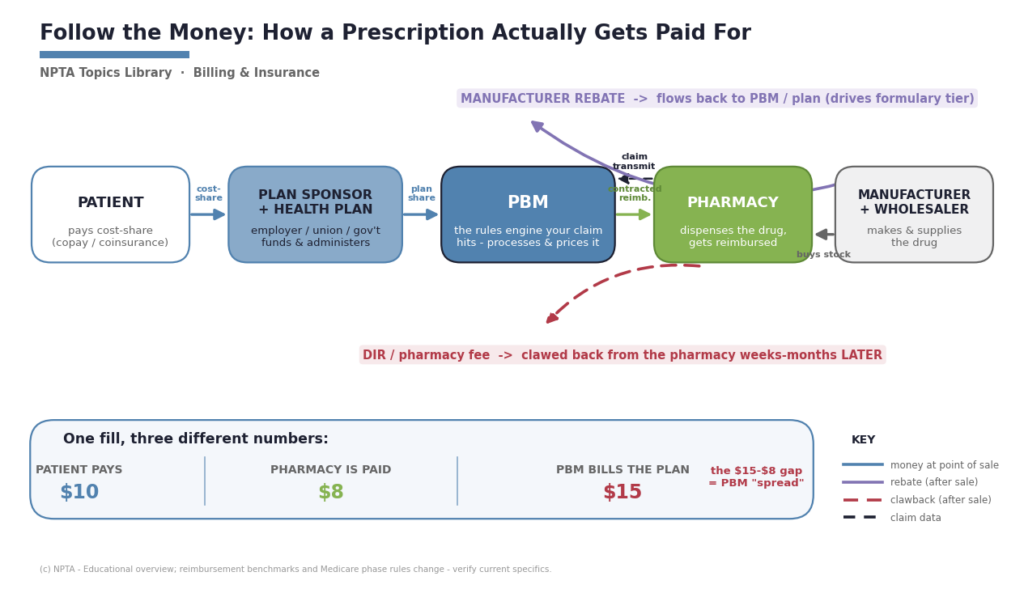
- The patient pays their cost-share (a flat copay, or a percentage coinsurance).
- The plan/PBM pays the pharmacy the rest — but only the contracted amount, not the pharmacy’s sticker price.
- Reimbursement basis — brand drugs are typically priced off a benchmark such as AWP or WAC; generics are usually capped by a MAC list. A dispensing fee may be added.
- After the sale, money keeps moving: manufacturer rebates flow back to the PBM/plan, and DIR fees can claw back money from the pharmacy weeks or months later.
- The “spread” — a PBM can bill the plan more than it pays the pharmacy and keep the difference.
So the price the patient sees, the amount the pharmacy actually keeps, and the amount the plan spends can all be three different numbers.
Why the patient’s price is what it is
- Formulary tier — preferred generics cost least; non-preferred and specialty cost most.
- Deductible — before it’s met, the patient may pay full contracted cost.
- Copay vs. coinsurance — a fixed dollar amount vs. a percentage.
- Coverage phase — in Medicare Part D especially, the same drug’s price shifts across the plan year as spending moves through the plan’s phases (deductible → initial coverage →, since 2025, an annual out-of-pocket cap).
If you remember one thing
- Your claim goes to the PBM, not directly to the insurer.
- The patient's price, the pharmacy's payment, and the plan's cost are often three different numbers.
- Generics are usually paid on MAC; brands off a benchmark like AWP.
- Rebates and DIR fees move money after the sale — invisibly.
The essentials above are free. NPTA members get the system one layer deeper — the PBM demystified, reimbursement math, Medicare & Medicaid in one screen, the “Follow the Money” walkthrough, and exam-style practice questions.
The PBM runs the benefit — processing, formulary, and reimbursement all sit with the middleman, not the insurer directly.
MAC (Maximum Allowable Cost) is the PBM's cap for generics — the reason two pharmacies can get paid differently for the same drug.
DIR/pharmacy fees are reconciled after the sale and can reduce what the pharmacy ultimately keeps.
Rebates are negotiated between manufacturers and PBMs/plans for formulary placement — they don't lower the patient's point-of-sale price directly.
Copay = fixed dollars; coinsurance = a percentage, so it scales with the drug's price.
When the PBM bills the plan more than it pays the pharmacy and keeps the difference, that's spread — the clearest example of why the patient's price, the pharmacy's payment, and the plan's cost are three different numbers.
Related topics
Billing & Insurance
Medicare Part B vs. Part D
Billing & Insurance
Understanding PBMs, Rebates & DIR